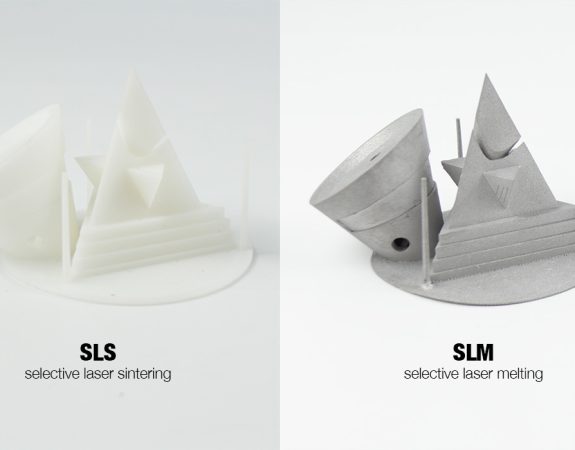
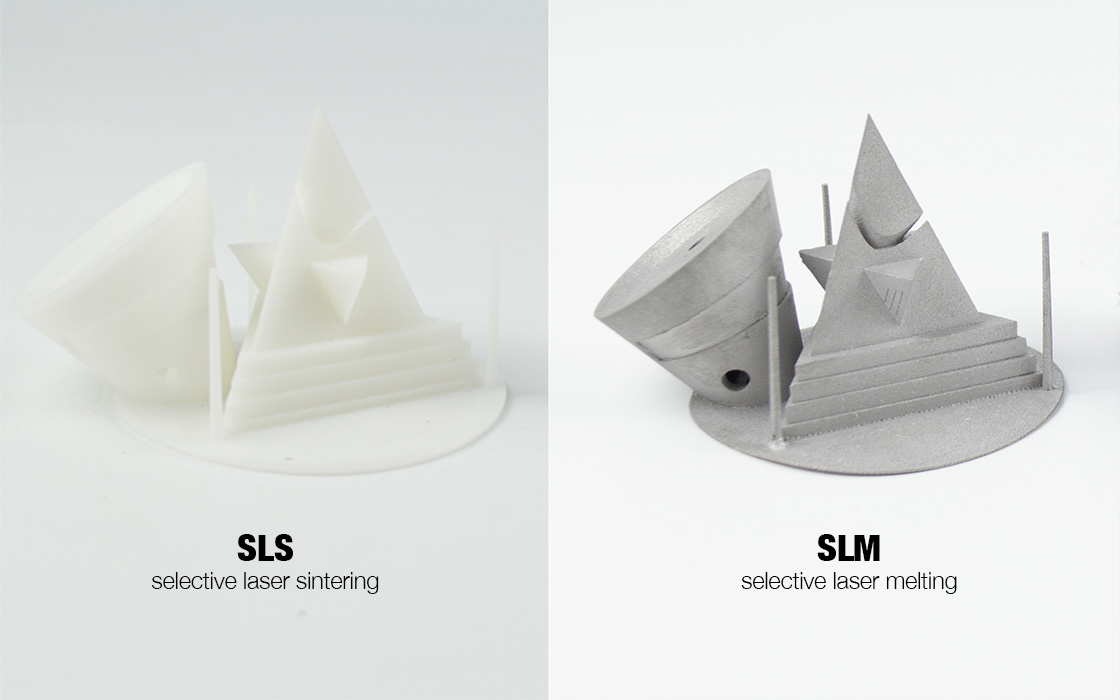
Selective Laser Sintering (SLS) and Selective Laser Melting (SLM) are Industrial Additive Manufacturing (AM) technologies that belong to the powder bed fusion family. Both processes build parts by thermally fusing powder particles layer by layer to form a solid object. Among 3D printing processes, SLS and SLM are typically best known for producing functional prototypes and end-use parts. While similar in many ways, SLS and SLM are two distinct processes.
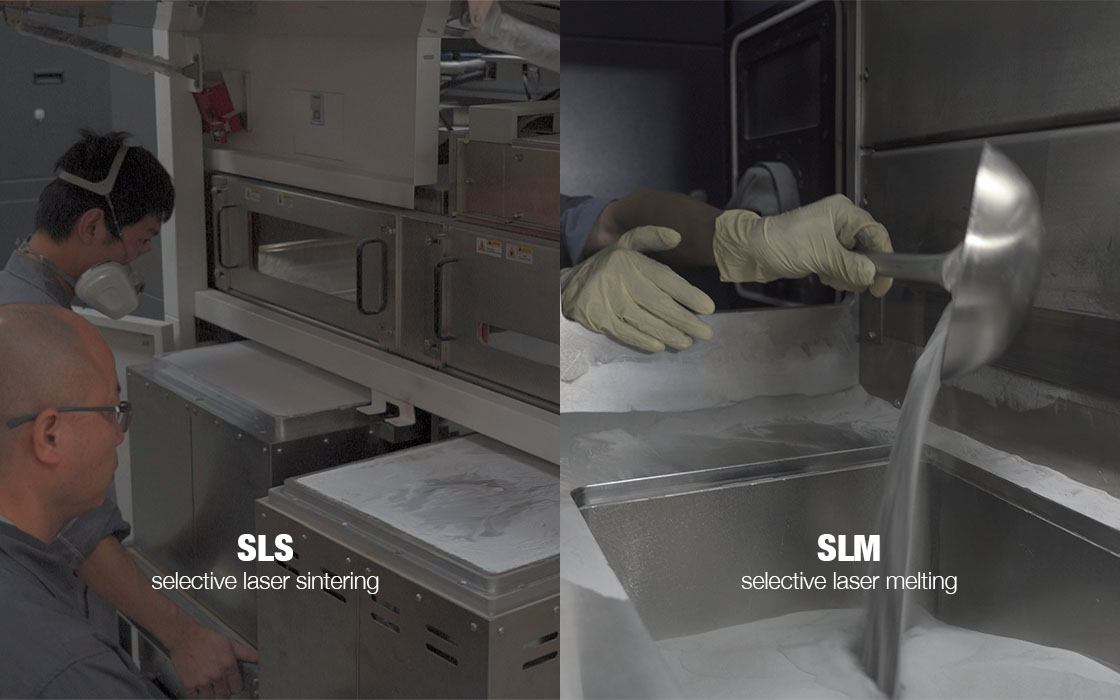
In the SLS process, a thin layer of powder is first spread across the build platform. A high-powered CO2 laser then selectively sinter and fuse together the polymer-based powder—typically Nylon 12—until it forms a layer. The build platform then lowers by one layer and the process repeats until the final part is complete. After printing, the whole powder bed must be left to properly cool off (usually 12 hours or more) before the part can be removed.
In the SLM process, a thin layer of powder is first spread over the build platform. A high-powered fiber laser then fully melts (rather than sinters) the metal powder, fusing it layer by layer to form the final part. Unlike SLS, SLM is performed in a highly controlled environment filled with inert gases, such as argon or nitrogen, to prevent oxidation and ensure proper melting and solidification.
| Selective Laser Sintering (SLS) | Selective Laser Melting (SLM) | |
|---|---|---|
| Build Volume | 400 × 400 × 450 mm | 280 × 280 × 280 mm |
| Typical Tolerance | ±0.3 mm | ±0.1 mm to ±0.3 mm |
| Layer Thickness | 0.1 mm (100 microns) | 0.02–0.08 mm (20–80 microns) |
| Pros |
|
|
| Cons |
|
|
| Applications | Ideal for rapid prototyping, creating functional parts like jigs and fixtures, enclosures, mechanical fittings, housings for electrical devices. | Ideal for rapid prototyping, creating functional parts, lightweight metal structures, high-performance applications and tooling. |
| Parts Need Support Structures | No | Yes |
| Require Escape Holes | Yes | Yes |
| Materials | Engineering thermoplastics (Nylon 12, glass and carbon-filled nylon, PP, TPU, etc.) | Metal alloys (Aluminium, Stainless Steel, Titanium, Inconel, Cobalt-Chrome, etc.) |
| Equipment Costs | $75,000 to $650,000 | $100,000 to $1,000,000+ |
| Material Costs | $20 to $80+ per kilogram | $50 to $100+ per kilogram; $300 to $600+ for high-performance alloys |
| Minimum Feature Size | 0.5 mm (0.75 mm recommended) | 0.4 mm (0.5 mm recommended) |
| Minimum Wall Thickness | 0.8 mm (1.5 mm recommended) | 0.7 mm (1 mm recommended) |
| Minimum Escape Hole Diameter | 3.5 mm (5 mm recommended) | 2.5 mm (3.5 mm recommended) |
| Design Guidelines | View SLS Design Guide ↗ | View SLM Design Guide ↗ |
SLM provides superior dimensional accuracy, typically achieving tolerances of ±0.1 mm to ±0.3 mm, with even tighter tolerances—down to about ±0.05 mm—possible through CNC post-processing on certain critical features. In contrast, SLS generally produces looser tolerances, often around ±0.3 mm or more depending on part size, material and geometry.
Industrial SLS 3D printers (400 x 400 x 540 mm) are typically larger than SLM printers (280 x 280 x 280 mm). One thing to note is that with SLS, parts can be nested anywhere within the three-dimensional (X, Y, and Z axes) space of the powder bed to maximize the use of space and material, which is generally not possible with metal printing due to heat management constraints, the need for support structures and other risks. This makes SLS printing particularly efficient and cost-effective for small-batch production.
These two technologies differ significantly in terms of materials. SLS printers primarily uses the polymer powder, Nylon 12 (PA12), but are also compatible with TPU elastomers, glass‑filled PA12 and Polypropylene (PP). In contrast, SLM is used for metals and can process a wide range of alloys, including aluminum alloys (AlSi10Mg), stainless steels (e.g., 316L, 17-4 PH), titanium alloys (Ti6Al4V) and specialty metals such as nickel-based superalloys and cobalt-chrome alloys.
Industrial SLM is significantly more expensive than SLS in terms of equipment cost, materials, operating expenses and post-processing requirements. Professional SLM printers typically cost between $100,000–$1,000,000 and up, depending on machine size, model and capabilities. Whereas, industrial SLS printers are typically around $75,000–$650,000.
In terms of material costs, SLS Nylon powder typically ranges from $20–$25 per kilogram in China and $30–$80 or more per kilogram in the US and Europe. In comparison, metal 3D printing materials generally start at $50–$100 per kilogram and can rise to $300–$600 or more per kilogram for high-performance and specialty alloys, such as nickel-based superalloys.
SLS parts do not require support, whereas SLM parts do—support removal is often more time-consuming for SLM than for plastic 3D printing due to the inherent characteristics of metal. Both processes produce parts with pretty rough and matte surfaces that require extensive post processing to achieve a smooth finish, but metal parts often require additional steps such as abrasive blasting. Both designs also require escape holes to allow for powder removal: at least 3.5 mm in diameter for SLS and 2–5 mm in diameter for SLM.
Because the metal material is completely melted and then solidified into a solid part, SLM-printed components contain fewer voids, resulting in higher density and superior mechanical strength compared to parts produced by SLS. Metals almost always outperform plastics in terms of mechanical properties, so there’s really no competition here. However, if strength-to-weight ratio is key, SLS PA12 parts can serve as a lower-cost alternative to metal.
Are you deciding between SLS and SLM 3D Printing for your project? The SLM vs SLS Table and Comparison Guide above, will help narrow down your decision. For expert advice or if you are ready to get a quote, submit your CAD drawing in STL file format to our ‘get-a-quote’ form, and we’ll get back with a quote within 24 hours or less.