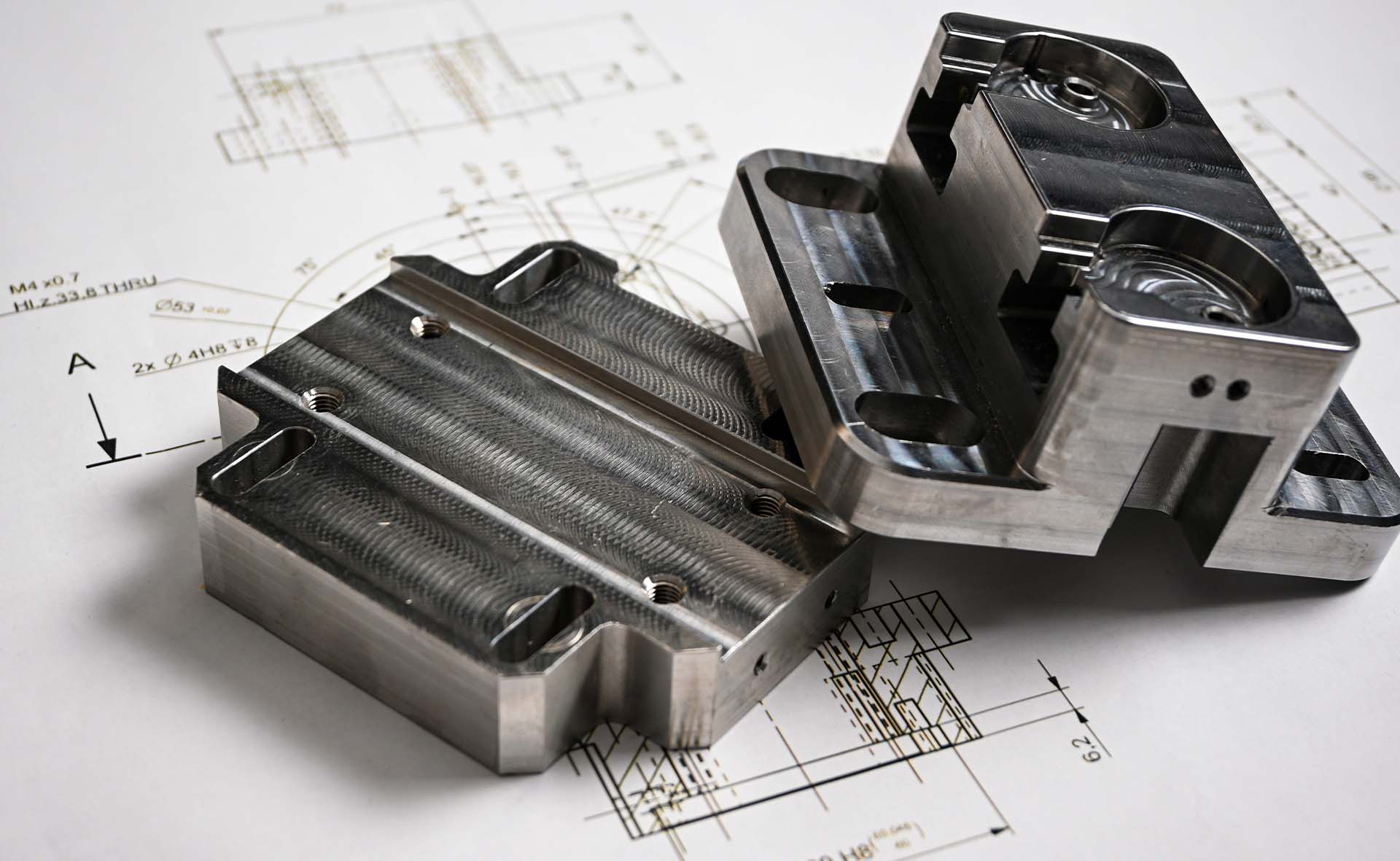
Get custom precision milled prototypes and parts from as fast as 4 days.
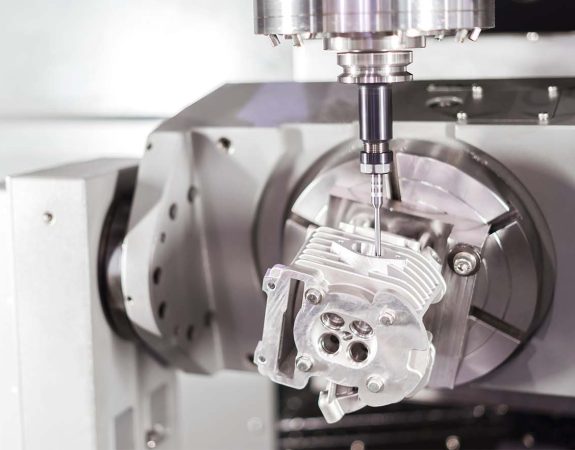
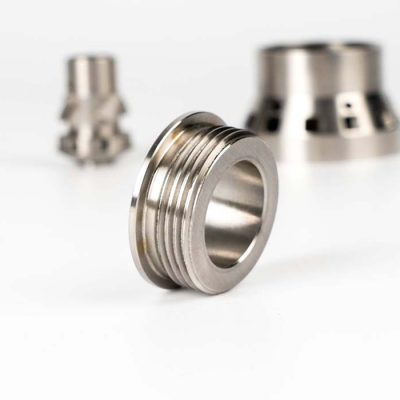
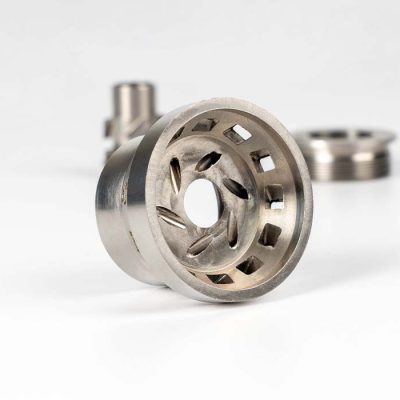
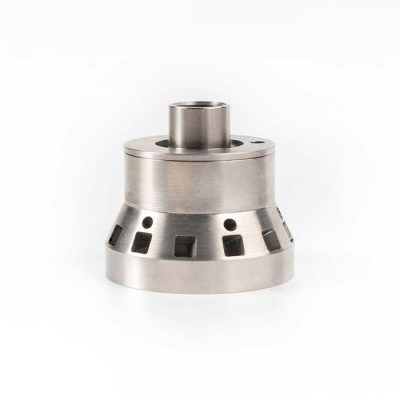
Part of our CNC Machining Services, our CNC milling process is suitable for one-off parts, rapid prototyping, and series production. CNC milling is a precision machining process that uses computer-controlled cutting tools to remove material from a solid workpiece. At HLH Rapid, we use 3-, 4- and 5-axis milling machines to manufacture parts ranging from simple components to highly complex geometries with tight tolerances. Simply upload your STEP file to get a fast quote and kick off your project.
Our range of CNC milling machines allows us to manufacture parts in a variety of shapes and sizes. 5-axis machining enables the production of complex geometries with fewer setups, while CNC gantry milling is suited to larger components.
| Metric units | Imperial units | |
|---|---|---|
| 3-axis | 1800 × 1250 × 800 mm | 70.9 × 49.2 × 31.5 inches |
| 4-axis | 850 × 550 × 550 mm | 33.5 × 21.7 × 21.7 inches |
| 5-axis | 1600 × 3000 × 1200 mm | 63.0 × 118.1 × 47.2 inches |
| CNC Gantry Milling Machine | 6000 × 3000 × 1000 mm | 236.2 × 118.1 × 39.4 inches |
| Aluminium 2014-T6 | Aluminium 7075-T6 | Stainless Steel 440C | Low Carbon Steel | Copper C110 | Magnesium Alloys |
| Aluminium 2024 | ADC12 | Stainless Steel 17-4PH | High Carbon Steel | Aluminium Bronze | Zinc Alloys |
| Aluminium 5052 | Stainless Steel 201 | Steel 1018 | A2 Tool Steel | Bronze | |
| Aluminium 6061 | Stainless Steel 301 | Steel 4140 | D2 Tool Steel | Brass C360 | |
| Aluminium 6061-T6 | Stainless Steel 304 | Steel 4340 | H13 Tool Steel | Lead Brass CZ112 | |
| Aluminium 6063 | Stainless Steel 316 | EN8 / C45 | Mild Steel | Lead Brass CZ121 | |
| Aluminium 6082 | Stainless Steel 316L | Hot Rolled Steel (HRC) | Inconel 625 | Titanium Grade 2 | |
| Aluminium 7075 | Stainless Steel 409 | Cold Rolled Steel | Inconel 718 | Titanium Grade 5 |
| ABS | FR-PC | PPSU |
| Acrylic (PMMA) | PE | PU Foam |
| Bakelite® | PEEK | PVC |
| HDPE | PEI | Silicone |
| LDPE | POM (Acetal/Delrin) | Durostone® |
| PA (Nylon) | Anti-static POM | |
| PA+GF | PP | |
| PBT | PPO | |
| PC | PPS | |
| PC+ABS | PPS-GF40 |
| As-Milled | Black Oxide | Hard Chrome Plating | Polishing | Spray Painting |
| Anodizing | Brushing | Laser Engraving | Powder Coating | Silk Screening |
| Alodine | Electroplating | Painting | Sandblasting | |
| Bead Blasting | Electroless Nickel Plating | Passivation | Smoothing |
Get a quote / Get in touch
Please use the following formats:
.stl, .obj, .wrl, .step (.stp), .iges (.igs), .3mf, .dxf and .zip
100mb max file size (per file)
If you have a file type not listed, please contact us to discuss first.
UK Office: Suite 11 & 12A, 44 Potternewton
Mount, Leeds, LS7 2DR, United Kingdom
Company Number: 12704810
VAT Number: GB393458263
Factory: Building A, Hongfa Industrial District
Houda Road, Daling Shan, Dongguan,
Guangdong, China
CNC milling, or Computer Numerical Control milling, is a subtractive manufacturing process that uses pre-programmed instructions and rotating cutting tools to remove material and shape a workpiece into a custom part. The two most commonly used milling machines in the industry are 3-axis machines, which are suited for simpler, basic shapes, and 5-axis machines, which are preferred for more complex geometries.
We follow ISO 2768 standards for CNC machining with tighter tolerances available on request.
| Limits for Nominal Size | Plastics (ISO 2768- m) | Metals (ISO 2768- f) |
|---|---|---|
| 0.5mm* to 3mm | ±0.1mm | ±0.05mm |
| Over 3mm to 6mm | ±0.1mm | ±0.05mm |
| Over 6mm to 30mm | ±0.2mm | ±0.1mm |
| Over 30mm to 120mm | ±0.3mm | ±0.15mm |
| Over 120mm to 400mm | ±0.5mm | ±0.2mm |
| Over 400mm to 1000mm | ±0.8mm | ±0.3mm |
| Over 1000mm to 2000mm | ±1.2mm | ±0.5mm |
| Over 2000mm to 4000mm | ±2mm |
To achieve high dimensional accuracy, reduce warping and successful prints, it is important that you design for the process. See the CNC Milling design guidelines below.
| Feature | Recommended Size (Metals) | Recommended Size (Plastics) |
|---|---|---|
| Minimum Wall Thickness | 1.0 mm (0.040 in) | 1.5 mm (0.059 in) |
| Minimum Engraved Detail Depth | 0.8 mm (0.031 in) | 0.8 mm (0.031 in) |
| Minimum Engraved Detail Width | 0.5 mm (0.0197 in) | 0.5 mm (0.0197 in) |
| Hole Depth | Up to 4× diameter | Up to 4× diameter |
| Minimum Hole Diameter | 1.5 mm (0.059 in) | 2.0 mm (0.079 in) |
| Minimum Pin Diameter | 2.0 mm (0.079 in) | 2.5 mm (0.098 in) |
| Threads | M2 or larger | M3 or larger |
| Thread Length | Up to 3× hole diameter | Up to 3× hole diameter |
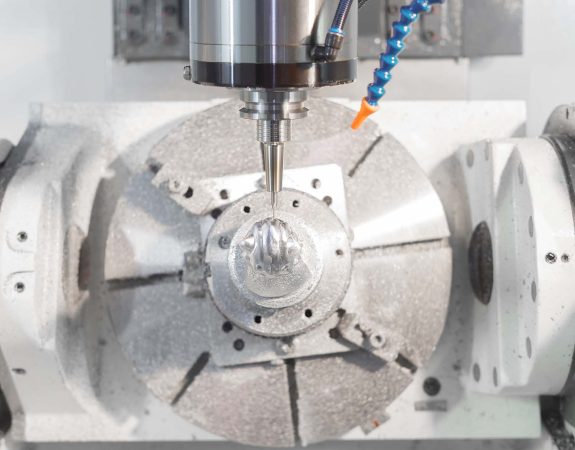
CNC milling machines are particularly effective for creating complex 3D shapes with very tight tolerances. They minimize human error and are compatible with a broad range of materials—over 200 at HLH—including metals, hard plastics, and composites. This versatility makes them suitable for a wide range of applications, such as precision medical devices, lightweight aerospace and automotive components, and more. The only real limitation is with soft plastics that are too flexible to machine accurately.
Simple CNC milled parts can often be machined in just a few hours, while more complex parts may take several days or even weeks. However, the total lead time also depends on factors such as setup, post-processing, quantity, and part complexity.
At HLH Rapid, CNC milling projects can be delivered in as little as 4 days, depending on the requirements of your project.
CNC milling typically costs $30–$40 per hour for 3-axis machining in Europe, while more advanced 5-axis milling can range from $75–$150 per hour. In China, where material, labour, and setup costs are generally lower, 3-axis CNC milling can start at around $10 per hour.
However, the final cost depends on factors such as part complexity, material, tolerances, machining time, setup requirements, and production location. For a detailed breakdown of CNC machining costs, read our guide: How Much Does CNC Machining Cost?
Want to know exactly how much your CNC milling project will cost? Submit .STEP file, get a quote without 24 hours or less.
The main difference is how the workpiece and cutting tool move.
In CNC turning, the workpiece rotates while a stationary cutting tool removes material. In CNC milling, the workpiece is typically held stationary while rotating cutting tools remove material. CNC turning is best suited to round or cylindrical parts, while CNC milling is ideal for creating features such as slots, pockets, holes, and flat faces. The two processes can also be used together to manufacture parts with more complex geometries.
Yes. Material certificates can be provided upon request for machined parts. Please specify your certification requirements when requesting a quote or placing your order.