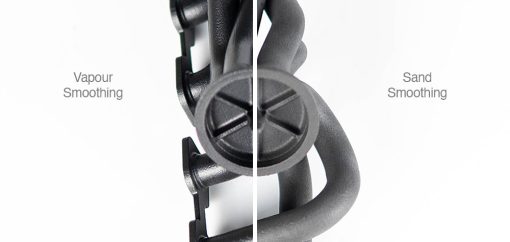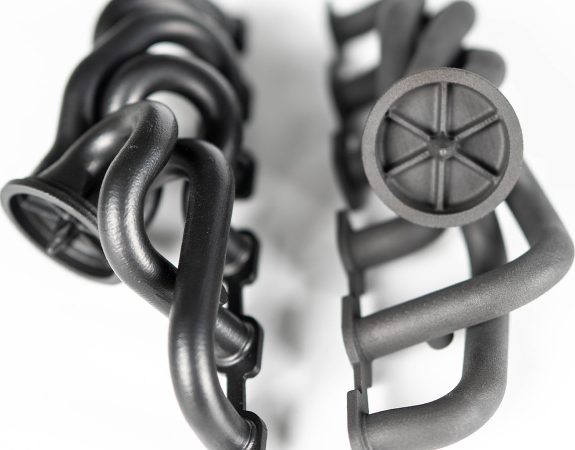
Vapour smoothing (also called vapour polishing) is a post processing technique used to smooth rough surfaces, and enhance the appearance, feel and performance of 3D printed parts. It is particularly effective for parts produced using Multi Jet Fusion (MJF) and Selective Laser Sintering (SLS). Vapour smoothing can also be combined with dyeing to produce parts with a smooth, coloured surface. The process creates a sealed, water-resistant finish with a smooth, and in some cases, glossy appearance.
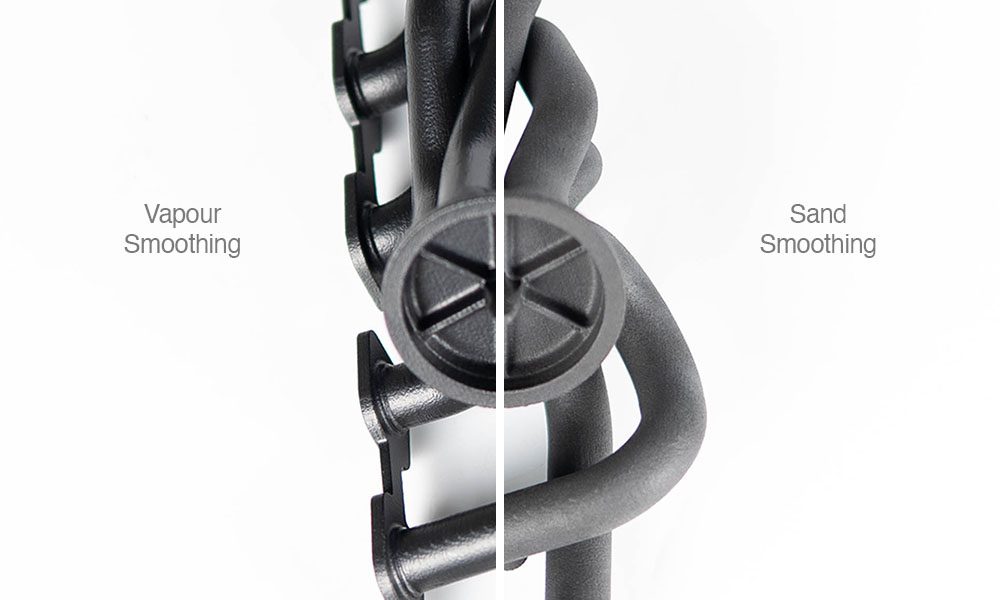
The process involves placing a cleaned 3D printed part into a sealed processing chamber, where it is exposed to a vapourised solvent, such as acetone or Methyl ethyl ketone (MEK), or a finishing agent, typically FA 326, to create a controlled chemical melt.
Maintaining proper temperature and pressure control is critical to ensure the vapour is uniformly distributed across the surface., while avoiding any damage to the workpiece. The solvent vapour condenses on the part’s surface and is allowed to dry and cool, creating a smoother and sealed surface.
The parts are typically left in the vapour smoothing chamber approximately 15 to 60 minutes (depending on part size and geometry), and the entire process, including drying and cooling, can take several hours.
So, what actually changes on the surface, and what are the other benefits of vapour smoothing?
Eliminates visible layer lines and reduces surface roughness from approximately Ra 6–10 µm after standard finishing to Ra 3–5 µm after vapour smoothing.
Seals the micro-gaps and pores between layer lines, reducing moisture absorption and creates a more airtight and watertight surface.
By smoothing and sealing the outer surface, vapour smoothing can improve impact resistance, fatigue performance, and elongation at break, resulting in more durable 3D-printed parts.
Uses an automated vapour polishing chamber which ensures consistent finish across all surfaces, including intricate and hard-to-reach areas.
Formlabs and AMT testing observed a 60% reduction in MRSA bacteria accumulation.
Vapour smoothing is typically more expensive than surface finishes like dyeing or abrasive (sand) smoothing. It often increases the initial 3D printed part cost by ~ 10% to 30% compared to standard deburr finish.
Vapour smoothing is an additional post processing step that requires part washing, vapor exposure, chemical melting, and precise curing, often increasing manufacturing lead time anywhere from 1 to 5 days.
Not all 3D printed parts can be vapour smoothed, neither is it suitable for all part geometries. It is mainly used to improve the surface of SLS and MJF printed Nylon 12 (PA12) parts. However, ABS, PLA and several other materials can also be vapour smoothed. If you have a custom application or are unsure whether your part is suitable, contact our team at info@hlhrapid.com for advice.
Vapour smoothing can soften fine surface details, textures and small embossed or engraved features. Intricate geometries may also become distorted during the process.
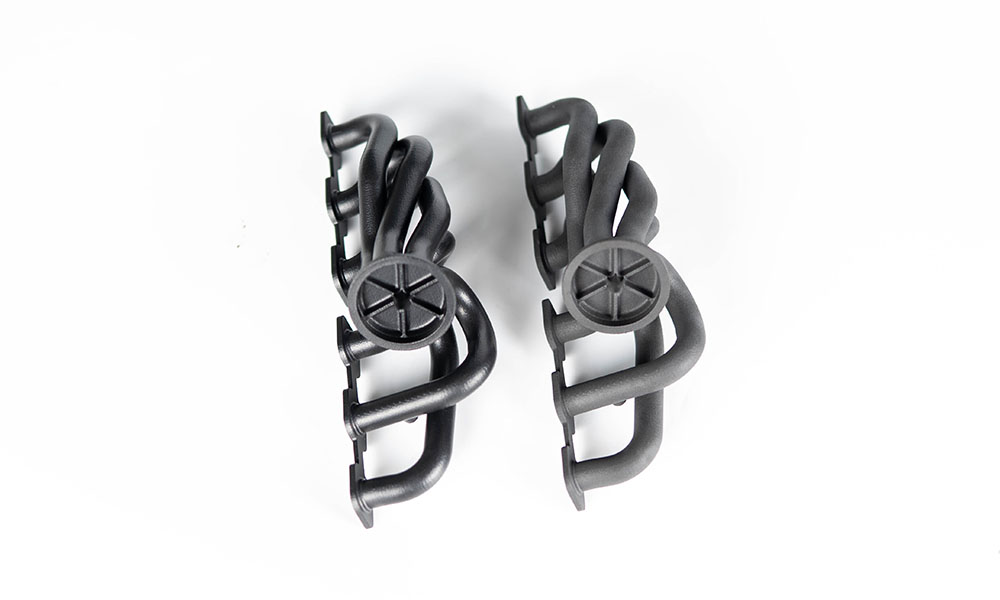
To help with your decision, vapour smoothing is commonly applied when:
At HLH Rapid, we offer vapor smoothing for MJF and SLS 3D printing (using PA 12). For custom surface finishing requests or if you are ready to get a quote, submit your CAD drawing in STL file format to our ‘get-a-quote’ form, and we’ll get back with a quote within 24 hours or less.